
Joshua Broder, MD, FACEP
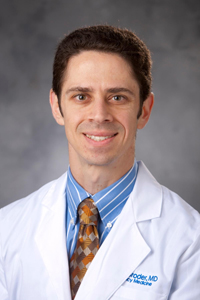
Joshua Broder, MD, FACEP is Professor and Vice Chair for Education and Faculty Development in the Department of Emergency Medicine at the Duke University School of Medicine
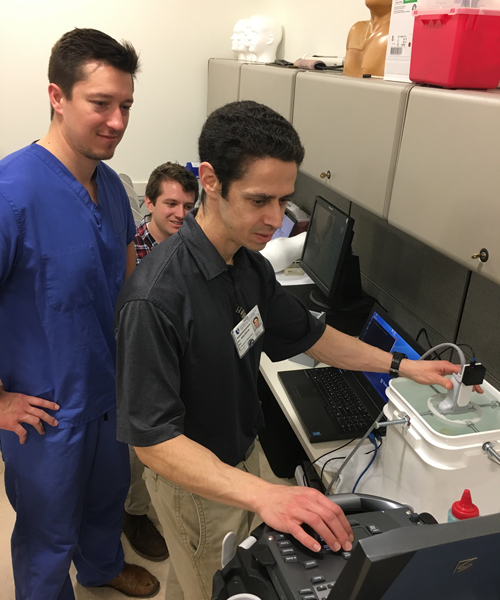
Dr. Broder’s engineering focus includes addressing human factors and biomedical device design to improve patient safety. He has published peer-reviewed root-cause analyses of device-related adverse events, as well as making suggestions to the US FDA and manufacturers, resulting in improved device labeling. He collaborated with undergraduate engineering students to develop a machine-learning algorithm to predict medical device recalls from publicly available data. With engineering partners, he developed a novel device to allow three-dimensional and multi-planar imaging with 2D ultrasound machines, earning Stanford-Coulter Foundation and Emergency Medicine Foundation Grants and resulting in numerous research presentations, publications, and an international patent application. He has helped to develop simulation devices for orthopedic procedural training. His research team -- composed of undergraduates as well as an MD-PhD Emergency Medicine resident -- has also developed an automatic control loop for blood pressure regulation in critical illness. This “thermostat for blood pressure” has been preliminarily validated in computer, benchtop, and animal models.
Mitchell Veverka, MD, MS
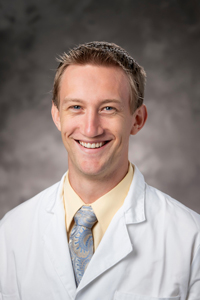
Mitchell Veverka, MD, MS, is an emergency physician and biomedical engineer whose work focuses on developing and translating new technologies to improve the delivery of emergency care. He earned his undergraduate degree in biochemical engineering from the Colorado School of Mines, his medical degree from Creighton University, and a master's degree in biomedical engineering from Duke University, where his training focused on medical technology design and commercialization. He subsequently completed his emergency medicine residency and research fellowship at Duke. His work in medical technology development has been supported through an R38 Research Fellowship, the Duke Barr-Spach Medicine and Engineering Scholarship, and the Duke Design Health program.
Dr. Veverka's research sits at the intersection of engineering, clinical medicine, and healthcare innovation. His work has included the development and clinical translation of photoacoustic imaging technologies for noninvasive physiologic assessment. More recently, his work has focused on applying digital health and clinical decision-support technologies to improve emergency department efficiency and diagnostic decision-making. He is developing a patient-facing platform that collects and synthesizes clinical information directly from patients before physician evaluation, with the goal of facilitating earlier diagnostic testing, supporting evidence-based clinical decision-making, and reducing delays in emergency care. Across his work, Dr. Veverka is particularly interested in identifying problems encountered at the bedside and applying principles from engineering, data science, and medical technology development to create practical solutions that improve patient care.